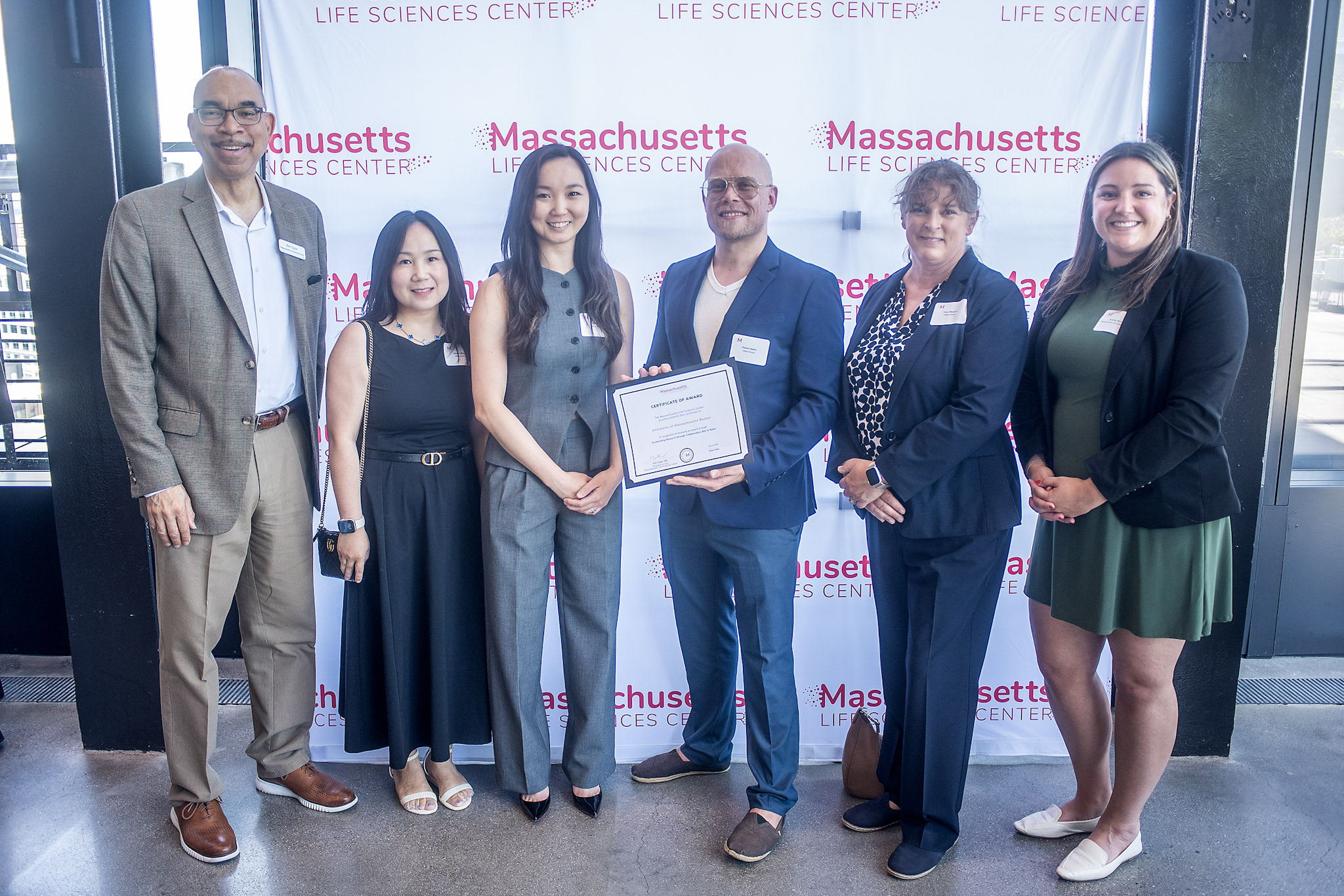
As the life sciences ecosystem becomes increasingly data-driven, access to high-quality resources is foundational to advancing scientific discovery and developing new approaches to diagnosis and treatment options. Through the Bits to Bytes track of the Massachusetts Life Sciences Center’s (MLSC) Accelerating Research through Collaboration (ARC) Awards, Daniel Haehn, PhD, Associate Professor of Computer Science and Director of the AI Research Core at the University of Massachusetts (UMass) Boston, received two awards to create large-scale datasets and leverage machine learning to advance breast cancer detection and support the development of non-invasive treatments for inflammatory diseases.
In 2020, the MLSC supported Dr. Haehn’s work alongside the Somerville-based health informatics company DeepHealth to create the Oregon-Massachusetts Mammography Database (OMAMA-DB), which includes approximately 165,000 2D mammograms with more than 7,000 cancer cases as well as approximately 67,000 3D tomosynthesis volumes with nearly 400 cancer cases, making it one of the world’s most comprehensive publicly available mammography databases. The data from this project is available through the MLSC’s Database, Algorithms, Tools, and Analyses (D.A.T.A.) Repository, giving researchers access to multiple versions optimized for machine learning that can be used to develop and evaluate new approaches to breast cancer imaging and detection. Since its release, the dataset has been downloaded more than 500 times, and the project’s development was recently published in the Journal of Medical Imaging. Additionally, DeepHealth hired postdoctoral researcher Hyunkwang Lee to work on the project, who now serves as the company’s Director of AI.
Building on these advancements, Dr. Haehn recently received an additional Bits to Bytes award in collaboration with INIA Biosciences, a Boston-based company leveraging non-invasive ultrasound with novel diagnostic sensing to treat chronic diseases. The project will create a large, openly available spleen ultrasound dataset with expert annotations and key demographic information. INIA Biosciences will hire a new postdoctoral researcher to work on this project, contributing to job creation in Massachusetts.
This new project will address a current challenge in developing non-invasive treatments for inflammatory diseases such as Crohn’s disease, rheumatoid arthritis, lupus, multiple sclerosis, psoriasis, and long COVID. Accurately locating the spleen is necessary for these treatments, but current methods for locating the spleen across patients are inconsistent and lack reliable data. By creating a new dataset and associated tools, the project aims to enable accurate, reproducible targeting and help accelerate the safe deployment of next-generation non-invasive therapies.
“The University of Massachusetts Boston is proud to partner with INIA Biosciences to create SPLEEN-US, the world’s largest open annotated ultrasound dataset of the spleen,” said Dr. Haehn. “This collaboration will advance AI-driven spleen imaging and support the development of precision neuromodulation therapies for chronic inflammatory diseases, with the goal of improving patient care.”
SPLEEN-US also builds on work completed by undergraduate students at UMass Boston who participated in Dr. Haehn’s AI course through the Immersive Mentored Practicum for AI/ML Career Training (IMPACT) program, an MLSC-funded initiative in which Dr. Haehn serves as Head Instructor. The program provides hands-on AI and machine learning training through intensive instruction, mentor-guided projects, and access to modern computing infrastructure. To date, the MLSC has invested more than $18 million in UMass Boston through its funding programs and sponsored more than 150 UMass Boston students through its internship programming. Together, these investments are helping strengthen the university’s capacity to pursue critical research, prepare the next generation of life sciences talent, and collaborate with industry and other research partners.
Read the recent award announcement here.